
From Asset‑Driven Needs to Capital Outcomes: Why Modern Capital Planning Requires a Connected Platform

For most owner organizations, capital planning does not start with projects. It starts with assets and the growing list of needs, risks, and opportunities associated with them.
In practice, that understanding is typically established through Facility Condition Assessments (FCAs). FCAs provide a structured, repeatable way to evaluate asset condition, lifecycle stage, and risk - creating a defensible foundation for capital planning decisions. Rather than relying on anecdotal inputs or static lists, organizations that integrate FCA results into their capital planning process can systematically identify, prioritize, and refresh capital needs over time.
FCA‑informed capital needs may include:
- Lifecycle replacements
- Capacity and program upgrades
- New Facility Requirements
- Deferred maintenance and renewal
- Regulatory, safety, and compliance requirements
- Energy, resilience, and sustainability initiatives
These needs are often captured at the asset or facility level, sometimes in facilities/asset management systems, and just as often in spreadsheets maintained by individual departments. Over time, organizations accumulate thousands of disconnected items that must be cataloged, estimated, prioritized, approved, funded, and delivered.
This is where many capital plans begin to lose clarity and control.
Planning Happens at the Asset and Work‑Element Level - Not the Project Level
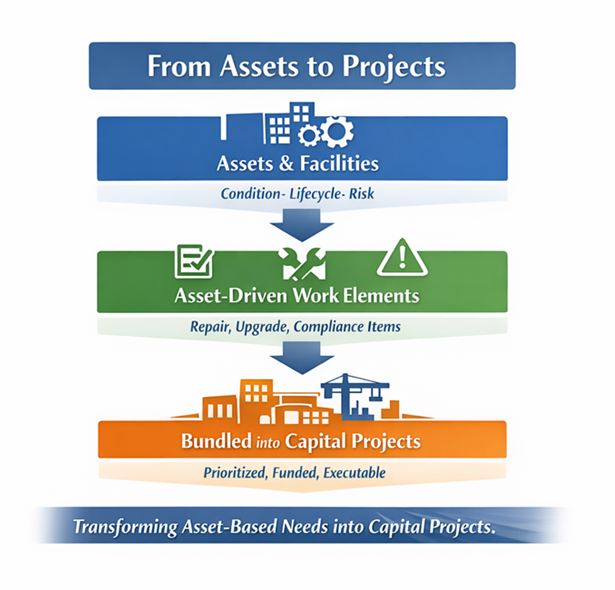
Before anything becomes a "project," it exists as a work element tied to an asset or facility-often derived directly from FCAs.
Facility Condition Assessments translate observed asset deficiencies, risks, and lifecycle needs into discrete, actionable work elements. These work elements form the bridge between asset data and capital planning, ensuring that proposed work is grounded in measurable conditions and documented need.
To become decision‑ready inputs to a capital plan, work elements should be:
- Collected and structured
- Estimated and evaluated
- Reviewed and approved for fiscal‑year spend
- Bundled into initiatives and potential projects
Once the initiatives/potential projects are approved and funded, their defining work elements should be tracked through execution and reported on after completion. This not only creates a closed loop for tracking but will also provide a knowledge/data source to support and inform future planning efforts.
When this process is managed across spreadsheets and disconnected systems, traceability is lost the moment execution begins.
Why Traceability Matters in Capital Planning
When asset‑driven planning data is disconnected from delivery systems, organizations struggle to answer fundamental questions:
- Which approved asset needs are actually being delivered?
- How much capital spend ties back to original asset drivers?
- Are we executing what was approved for this fiscal year?
- What did we actually deliver for the money we spent?
- How can ongoing work estimates be refined by the experience of actual costs occurring on projects.
Without a system that connects assets, work elements, initiatives, plans, projects, and financials, capital planning becomes static and execution becomes reactive.
How PMWEB Connects Assets, Planning Requirements, and Capital Delivery
PMWEB was designed to support owner organizations in managing capital programs from early planning through execution and long‑term reporting.
1. Facility Condition Assessments and Asset‑Centric Planning Inputs
PMWEB can support Facility Condition Assessment workflows either by managing assessment activities within the platform or by integrating assessment outputs from external tools.
PMWEB's asset and facilities capabilities can maintain asset hierarchies and store condition and lifecycle attributes. As condition data is refreshed, organizations can use PMWEB to create and update associated work elements so that capital planning inputs remain aligned with current conditions.
Asset-Centric Planning and Synchronization in PMWEB shifts FCA outputs from static reports to a living, system‑driven planning inventory.
2. Flexible Integration with Existing Facilities and EAM Systems
PMWEB does not require organizations to abandon existing facilities or asset management systems. Where organizations already use FM/EAM solutions, PMWEB can synchronize key asset data and planning inputs so that condition and lifecycle information remains connected to portfolio planning and delivery.
This flexibility allows PMWEB to act as:
- The system of record for capital planning and execution
- A synchronized representation of Assets maintained in established FM/EAM solutions
- A hub that connects asset condition and planning data to capital funding decisions
3. Fiscal‑Year Review, Approval, and Funding Alignment
PMWEB supports structured workflows that allow planning work elements (whether captured directly or synchronized) to be reviewed, prioritized, and approved as part of an annual or multi‑year capital planning process.
4. Initiatives: Bundling Work Elements into Decision‑Ready Packages
To move from thousands of discrete work elements to strategic choices, organizations group related work into initiatives.
Initiatives represent logical bundles of related work elements (e.g., renewal packages by facility, system, geography, risk class, or funding source). They help leadership compare options without prematurely committing to project execution structures.
PMWEB initiatives are designed to facilitate various components of project planning such as weighted scoring/ranking, cost estimation, and preliminary scheduling. Initiatives are also designed such that the planning components transition directly into active projects such as utilizing the approved estimates to generate project funding/budgets and transitioning the preliminary schedule into the fully managed project schedule.
5. Portfolio Plans and Scenario‑Based Capital Strategy
Portfolio Plans act as the governance layer between asset‑driven needs and project execution.
PMWEB supports multiple Portfolio Plans, each representing a collection of initiatives (and their underlying work elements). Plans can represent:
- The entire capital plan, or
- A component plan (with multiple plans collectively forming the full program)
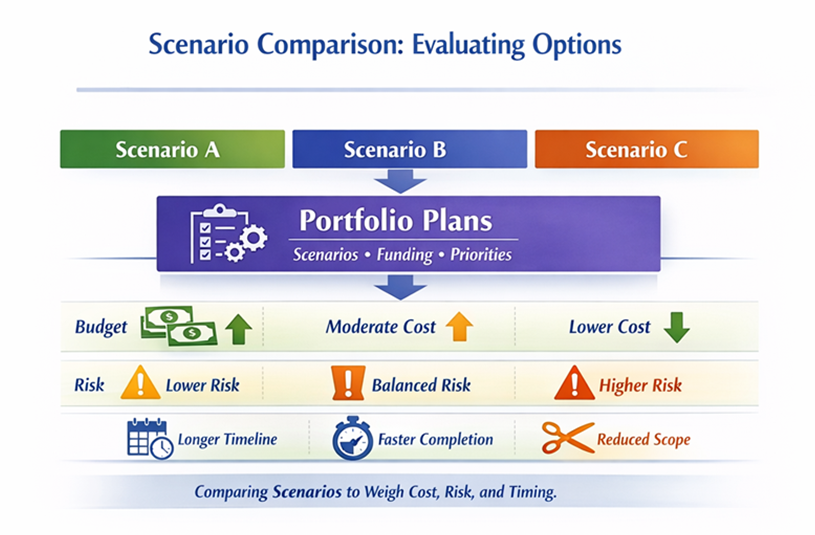
Plans can also be used to develop and compare scenarios, enabling decision‑makers to evaluate funding options, priorities, and trade‑offs before committing to a final path forward.
Scenario planning is not just about "what fits" in a budget. It also clarifies risk and consequence: what exposure increases if work is deferred, what lifecycle impacts accumulate, and what portfolio health improves when the right work is accelerated.
Once approved, Portfolio Plans can be used to authorize, fund, and launch the projects and programs that will deliver the approved scope.
6. Reporting Execution Back to Assets, Work Elements, and Plans (Reporting as Learning)
During execution, PMWEB can connect schedules, commitments, changes, and actual costs back to:
- The Projects
- The approved Work Elements
- The Portfolio Plans and Initiatives that authorized them
This enables reporting of progress, cash flow, and spend not only at the project level, but back to the original planning drivers.
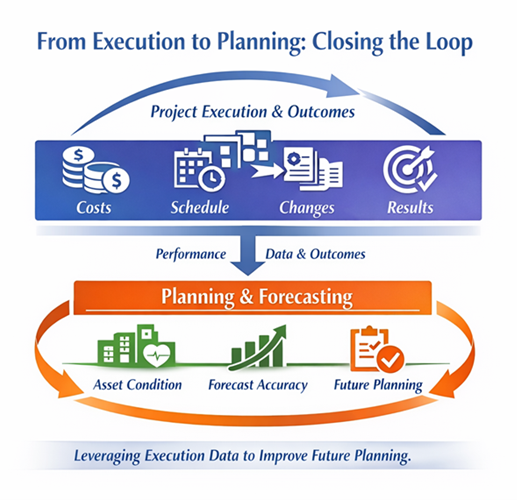
Importantly, this reporting becomes a learning mechanism: actual costs, schedule performance, and delivered outcomes validate planning assumptions, improve future estimating, and strengthen long‑range capital strategy.
Capital Planning as a Continuous, Asset‑Driven Process
Capital planning is not a one‑time exercise. It is a continuous, asset‑driven process that evolves as conditions change, work is completed, and priorities shift.
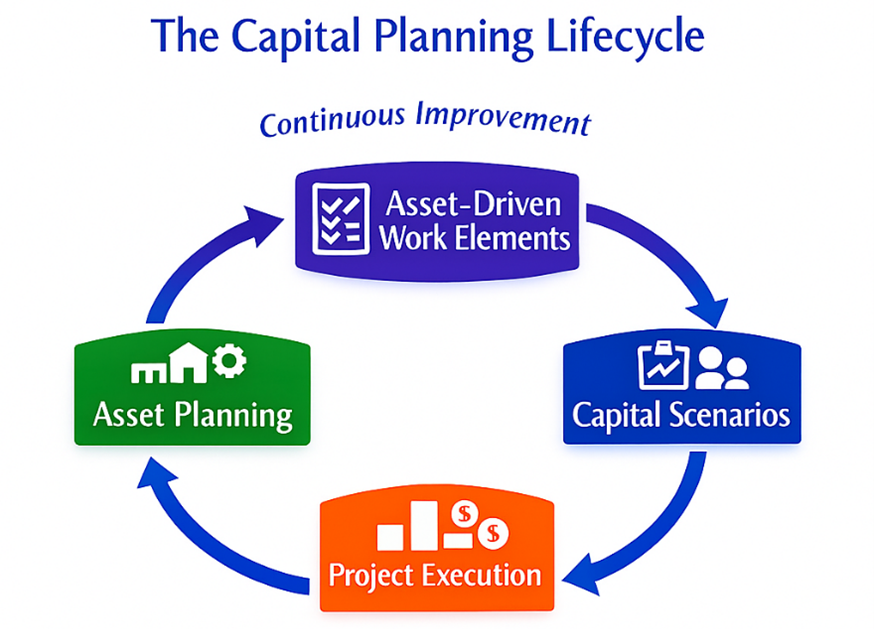
Facility Condition Assessments should not be treated as one‑time studies. As assets age and work is executed, condition data must be refreshed so that work elements, initiatives, and scenarios remain aligned to the real portfolio.
Execution outcomes (actual cost, schedule performance, and delivered scope) feed back into asset condition and future FCA cycles, closing the loop between planning assumptions and real‑world results.
Execution outcomes are not the end of the capital planning process. They are critical inputs to the next planning cycle.
Where HKA Tech Adds Value: Advisory and Implementation to Align PMWEB With Your Strategy
Technology alone does not solve capital planning challenges. The real value comes from aligning strategy, governance, data, and execution.
HKA Tech helps owner organizations:
- Define capital planning frameworks and governance models
- Design and implement Facility Condition Assessment strategies that integrate with capital planning and PMWEB‑based workflows
- Structure asset, work‑element, initiative, and portfolio data to support decision‑making
- Design Portfolio Plans and scenario approaches aligned to funding realities and organizational priorities
- Configure and implement PMWEB to reflect how the organization plans and delivers work
- Integrate critical systems with PMWeb such as FM/EAM, FCM, GIS and Finance
- Establish a reporting and data strategy that closes the loop between planning assumptions and delivered outcomes
- Leverage advanced AI tools that enable users to interact with and gain actionable insights from their capital planning and project execution data, harnessing large language models to support informed decision-making.
By combining advisory insight with disciplined PMWEB implementation, HKA Tech helps owners move from disconnected planning inputs to executable, defensible, and measurable capital programs.
Capital planning success isn't about software alone. It's about aligning strategy, governance, and execution. With the right advisory approach, platforms like PMWEB become powerful engines for capital outcomes.